Product Description:
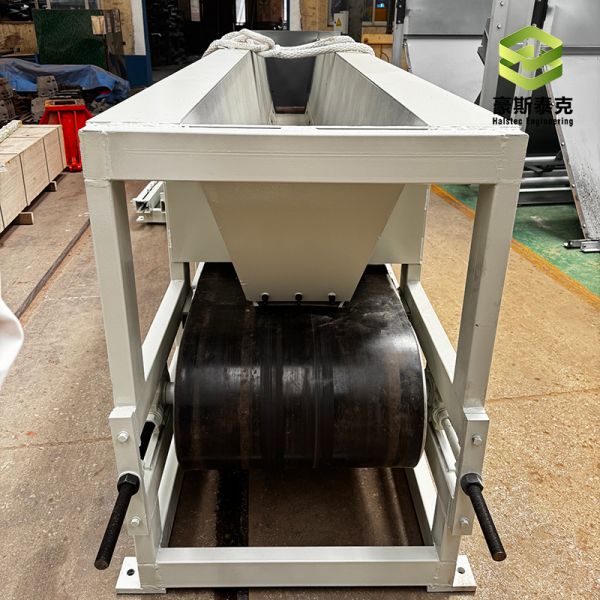
Box feeders are specialized quantitative feeding devices for the brick, tile, building materials, mining, and coal industries. They are primarily used for the continuous and uniform conveying of bulk materials such as clay, shale, coal gangue, and sand. The equipment features a robust overall structure and stable operation. Equipped with a dual adjustment structure for frequency conversion speed regulation and gate opening, it can precisely control the feeding rate to adapt to different production conditions and capacity requirements.
The entire machine adopts a closed box design, which is dustproof and environmentally friendly. It features wear-resistant conveying components and a powerful transmission system, making it wear-resistant, impact-resistant, long-lasting, and with a low failure rate. Compared to traditional feeding equipment, this machine integrates storage and feeding functions, eliminating the need for additional storage facilities and effectively saving floor space and equipment investment. Its simple and reasonable structural design makes installation and maintenance convenient. It can operate continuously and stably for 24 hours, significantly reducing operating costs. It provides stable material conveying for the entire production line, including crushing, mixing, and brick making, making it an ideal supporting equipment for industrial and mining building materials production lines.

Features:
-Highly adaptable: Capable of conveying viscous materials with a moisture content up to 20%, effectively solving material sticking and clogging problems compared to disc feeders or vibrating feeders.
-Uniform and stable: Dual control via "gate + frequency conversion speed regulation" allows for a wide range of feed rate adjustments, ensuring uniform feeding to subsequent crushers or extruders and improving finished product quality.
-Durable structure: Large housing volume acts as a buffer, meeting the needs of continuous operation. The chain plate type uses wear-resistant steel plates and high-strength chains, suitable for materials with high hardness and large block size, with a long service life.
-Easy maintenance: Simple and reliable structural design with few vulnerable parts. To address belt misalignment, the improved equipment adds an automatic cleaner to the return section, effectively cleaning belt debris and protecting the belt.
Technical Parameters:
| Product Name |
Box Feeder |
| Power |
7.5kw |
| Feature |
Easy Operation |
| Control System |
Automatic |
| Structure |
Belt, Frame, Roller |
| Certification |
ISO9001 |
| Environmental |
Friendly |
| Use For |
Brick Factory |
| Capacity |
30-70m3/hr |
Applications:
-Brick and tile industry: Processes clay, shale, coal gangue, etc., feeding them evenly into mixers or extruders, and can achieve proportional blending of internal combustion pulverized coal.
-Expanded aggregate/lightweight aggregate industry: Transports raw materials such as fly ash and sludge, ensuring accurate batching.
-Other industries: Used in metallurgy, chemical industry, coal mining, and other fields for conveying loose granular materials or powders (requires a closed structure).

Structure Composition and Working Principle:
Structural Composition: The equipment mainly consists of a housing (hopper), conveyor belt (or chain plate), gate adjustment device, rotary cutter feeding device, drive unit (motor, reducer), and frame.
Working Principle: The motor drives the drive roller through the reducer, which in turn drives the conveyor belt in a cyclical motion. Material enters the housing from the top and accumulates on the conveyor belt. The material layer thickness is controlled by adjusting the gate height, and the flow rate is controlled by adjusting the belt speed. These two factors combined achieve precise quantitative feeding. For wet, sticky materials prone to bridging, the rotary cutter or feeding bar equipped with the equipment can actively break up loose, muddy materials, preventing bridging and ensuring smooth material flow.
Selection Suggestions:
-Material Characteristics: For wet, sticky materials (such as clay), a belt-type box feeder with a feeding device is preferred; for lumpy or hard materials (such as coal gangue), a chain-plate box feeder is recommended, and the feeding bar should be eliminated or the chain strength strengthened.
-Feeding Capacity Requirements: Select the appropriate belt width model based on the production line capacity (e.g., brick machine hourly output). A 20% margin of safety is generally recommended.
-Moisture Content Considerations: If the material moisture content consistently exceeds 20%, special anti-sticking treatment or a larger inclination angle is required at the feed inlet to prevent material bridging.


